
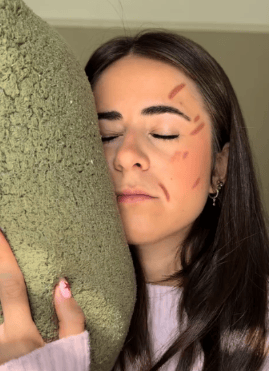
You know those lines you sometimes wake up with across your cheek after sleeping on your side?
They are often called sleep lines or sleep wrinkles.
Unlike expression lines, which are associated with repeated facial movements such as smiling, squinting or frowning, sleep lines are linked to the way the face is pressed, folded and distorted against a sleeping surface.
For many people, the creases they notice first thing in the morning fade fairly quickly. But as skin changes with age and loses some of its elasticity, repeated mechanical pressure during sleep has been proposed as one factor that may contribute to more persistent sleep wrinkles.
So what actually causes sleep lines, are they the same as normal wrinkles, and can you do anything to reduce them?
What Are Sleep Lines?
Sleep lines are facial creases associated with mechanical pressure and distortion of the skin during sleep.
When you sleep on your side or stomach, parts of your face can be pressed against your pillow for prolonged periods. Depending on your sleeping position, the skin may experience a combination of compression, shear, stretching and folding.
Researchers studying sleep wrinkles have observed that these forces can produce characteristic facial distortions that are different from those created by facial expressions.
That distinction matters because not every line on your face forms for the same reason.
Sleep Lines vs Expression Wrinkles
Expression wrinkles develop in areas repeatedly moved by the underlying facial muscles.
Think of crow's feet when you smile or the lines that appear between your eyebrows when you frown.
Sleep lines are different because they are associated with external mechanical forces acting on the face rather than muscle contraction alone.
A 2016 review published in Aesthetic Surgery Journal described how side and stomach sleeping can subject the face to compression, shear and stress.
Earlier experimental research also photographed facial deformation when participants positioned their faces against a simulated sleep surface.
This does not mean sleeping on your side guarantees permanent wrinkles.
Skin ageing is complex, and factors including sun exposure, genetics, age, smoking and normal facial movement all influence wrinkle development.
Sleep position is better understood as one potential mechanical factor within that much larger picture.
Why Do You Wake Up With Lines on Your Face?
If you wake with a crease running across your cheek, the explanation can be surprisingly simple.
Your face may have remained pressed into your pillow for a prolonged period.
The weight and position of your head can push facial tissue against the sleeping surface, temporarily folding or compressing the skin.
Younger skin generally has greater elasticity and may recover from this deformation relatively quickly.
As skin ages, however, its structural properties change.
Collagen and elastin are important components of the skin's extracellular matrix. Research into skin ageing shows that collagen becomes increasingly fragmented and disorganised with age, while overall elasticity declines.
This helps explain why a crease that disappears quickly in younger skin may take longer to resolve later in life.
It does not mean every morning pillow mark eventually becomes a permanent wrinkle.
The available research simply provides a plausible reason why repeated mechanical deformation becomes more relevant as skin loses resilience.
Can Side Sleeping Cause Sleep Lines?
Side sleeping creates considerably more facial contact with a pillow than back sleeping.
When lying on your side, your cheek and surrounding tissue can be pushed against the pillow as the weight of your head meets the sleep surface.
Researchers examining sleep wrinkles have specifically identified side and stomach sleeping as positions in which facial compression and distortion occur.
However, there is an important distinction between saying that side sleeping creates facial compression and saying that side sleeping will give you wrinkles.
The first is supported by biomechanical research.
The second is far too absolute.
Wrinkle formation is multifactorial, and long-term clinical evidence specifically investigating sleeping position remains much more limited than research into established causes of skin ageing such as ultraviolet exposure.
If you are a side sleeper, there is no reason to panic.
It simply makes sense to consider how much pressure your face experiences against your sleeping surface.
Do Sleep Lines Go Away?
The temporary lines you notice when you first wake often do.
How quickly they disappear will vary depending on the person, the depth of the crease and the characteristics of the skin.
A morning sleep crease and an established wrinkle are not necessarily the same thing.
This distinction is particularly important when discussing anti-wrinkle sleep products.
No pillow, pillowcase or sleeping position should reasonably be presented as a guaranteed way to prevent skin ageing.
A more realistic goal is to reduce unnecessary mechanical pressure and facial compression during sleep.
Why Sleep Lines May Become More Noticeable With Age
Skin does not behave the same way throughout life.
With intrinsic ageing, changes occur in the dermis and extracellular matrix, including collagen fragmentation and reduced structural support.
Sun exposure can accelerate many visible signs of ageing further.
As the skin becomes less resilient, it may not rebound from mechanical deformation as efficiently as it once did.
This provides a reasonable biological explanation for something many people notice themselves: pillow marks that disappeared almost immediately when they were younger can sometimes remain visible for longer as they age.
Again, this does not prove that every temporary sleep crease becomes permanent.
It means the interaction between mechanical forces and ageing skin deserves consideration.
Where Do Sleep Lines Usually Appear?
Their location depends partly on the way you sleep and where the face contacts the pillow.
Common areas include the cheeks, around the eyes, forehead, between the brows and around the mouth.
Sleep wrinkles may also have a different orientation from expression wrinkles because the forces producing them are different.
This is one reason researchers distinguish sleep wrinkles from facial expression lines rather than treating all wrinkles as the same phenomenon.
How Can You Reduce Sleep Lines?
There is no single solution because skin ageing has many causes.
However, there are sensible ways to address both the health of the skin itself and the mechanical environment surrounding it.
1. Protect Your Skin From UV Exposure
If your goal is to prevent premature skin ageing, daily sun protection remains considerably more established than any sleep-related intervention.
Reducing overnight facial pressure should complement good skincare habits, not replace them.
2. Consider Your Sleeping Position
Back sleeping generally results in less direct facial contact with the pillow than side or stomach sleeping.
For some people, sleeping on their back may therefore reduce overnight facial compression.
But sleep quality matters too.
If you are a lifelong side sleeper, forcing yourself into an uncomfortable position every night simply for cosmetic reasons may not be realistic.
3. Consider the Shape of Your Pillow
This is where pillow design becomes relevant.
A conventional pillow provides a relatively continuous surface for the side of the face to press against.
A contoured beauty pillow takes a different approach by creating space around parts of the face while still supporting the head.
The objective is not to claim that a particular pillow can stop ageing.
Instead, it is about changing the physical sleep environment in a way intended to reduce unnecessary facial contact and compression.
4. Think About the Surface Touching Your Skin
Pillow shape and pillowcase material are two separate considerations.
A smoother pillowcase changes the surface against which your skin moves.
A contoured pillow changes the shape and positioning of the sleeping surface.
This is why a silk pillowcase and a beauty pillow are not necessarily competing solutions. They address different parts of the sleep environment.
5. Support Your Skin Barrier
Dry or compromised skin may make fine lines appear more noticeable.
A sensible skincare routine, appropriate moisturisation and daily SPF remain important regardless of the pillow you sleep on.
Can a Silk Pillowcase Prevent Sleep Lines?
Silk pillowcases are popular in beauty routines because of their smooth surface.
But it is important to distinguish friction from compression.
A smoother material may alter the amount of friction between your skin, hair and bedding.
However, changing the pillowcase material does not fundamentally change the shape of the pillow beneath your head.
If your cheek is still pressed firmly into the pillow, facial compression can still occur.
That is why someone particularly concerned about overnight facial pressure may want to think about both the pillow surface and the pillow's physical shape.
What Is a Beauty Pillow?
A beauty pillow is designed with more than general head support in mind.
Typically, it uses specialist shaping or contours intended to create additional space around parts of the face.
The idea is straightforward. Rather than allowing the cheek to press into one continuous pillow surface, the design attempts to accommodate the face differently during side sleeping.
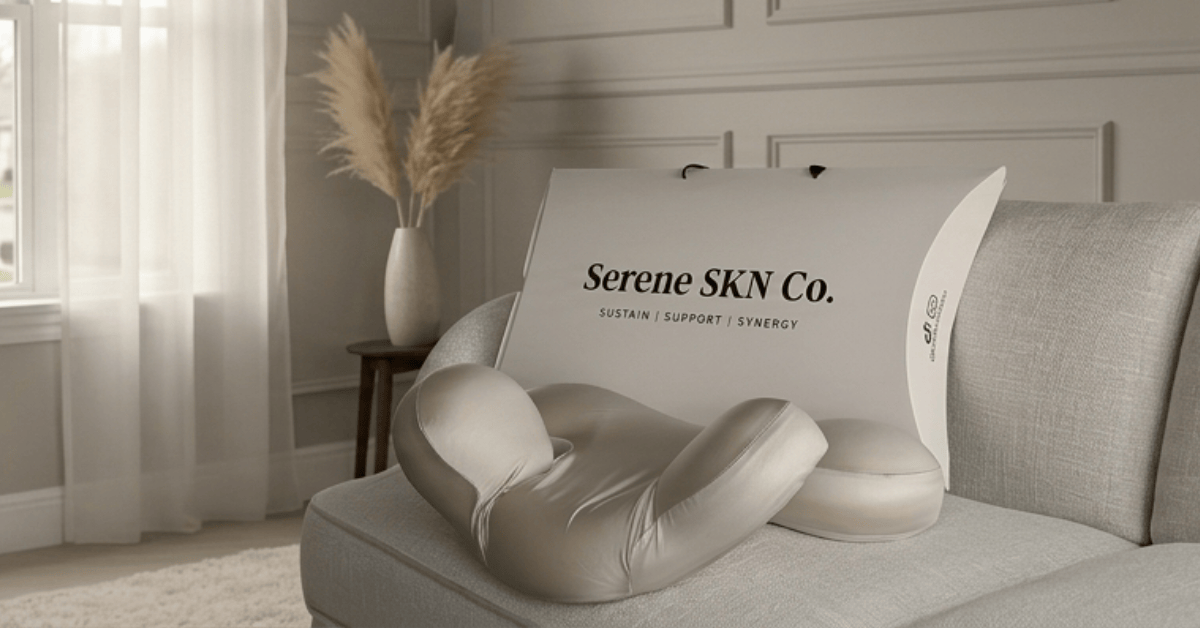
At Serene SKN Co, this is the thinking behind our Beauty Pillow.
It was created to complement the care you already give your skin by considering something traditional skincare routines rarely address: what happens to your face during the hours after you apply your evening skincare.
A beauty pillow is not a replacement for SPF, skincare, healthy sleep or professional dermatological treatment.
It is another part of the sleep environment to consider.
Are Sleep Wrinkles Permanent?
Some sleep-related creases are temporary.
Established wrinkles, however, involve structural changes in ageing skin and are not simply morning pillow marks that have not disappeared yet.
This is another reason we avoid treating sleep lines as one single condition.
There is a spectrum between temporary mechanical creasing and persistent wrinkles.
Reducing facial compression is therefore best approached as a preventative consideration rather than a promise to reverse established wrinkles.
Should You Stop Sleeping on Your Side?
Not necessarily.
Sleep is important for overall health, and comfort matters.
If you naturally sleep on your side, you do not need to spend every night worrying about your face touching your pillow.
A more practical approach is to optimise the environment around the way you already sleep.
That could mean considering your pillow design, pillowcase, skincare routine and general sleep habits rather than trying to completely retrain your sleeping position.
The Bottom Line
Sleep lines are different from expression wrinkles.
Research has shown that when we sleep on our side or stomach, the face can experience compression, shear and mechanical distortion against the sleeping surface.
Temporary morning creases often disappear.
Whether repeated sleep-related deformation contributes to persistent wrinkles over many years is biologically plausible and discussed within the scientific literature, but the available clinical evidence is not strong enough to justify dramatic claims that side sleeping inevitably causes wrinkles.
The most sensible approach is not to fear sleep. It is to reduce unnecessary facial compression where practical while continuing to focus on the fundamentals of healthy skin: sun protection, appropriate skincare and good-quality sleep.
For people who naturally sleep on their side, the design of the surface they spend several hours resting against each night is simply another factor worth considering.
Sleep Lines FAQs
What Causes Sleep Lines?
Sleep lines are associated with mechanical compression and distortion of facial skin against a sleeping surface, particularly during side and stomach sleeping.
Are Sleep Lines Different From Wrinkles?
Sleep lines and expression wrinkles can form through different mechanical processes. Expression wrinkles are strongly associated with repeated muscle movement, while sleep lines are associated with external compression and deformation during sleep.
Do Sleep Lines Disappear?
Temporary morning sleep creases often fade after waking. How quickly they disappear varies between individuals and may change as skin becomes less elastic with age.
Can Sleeping on One Side Cause Wrinkles on That Side?
Side sleeping can create greater facial compression on the side contacting the pillow. Research supports the existence of these mechanical forces, although it does not establish that everyone who sleeps on one side will develop permanent wrinkles there.
Is Sleeping on Your Back Better for Sleep Lines?
Back sleeping generally reduces direct contact between the face and pillow, so it can reduce facial compression. However, comfort and sleep quality should also be considered.
Can a Beauty Pillow Prevent Wrinkles?
A beauty pillow should not be considered a guaranteed way to prevent wrinkles. A contoured design can instead be understood as a way of reducing unnecessary facial contact and pressure during sleep.
References
Anson G, Kane MA, Lambros V. Sleep Wrinkles: Facial Aging and Facial Distortion During Sleep. Aesthetic Surgery Journal. 2016.
Sarifakioglu N, Terzioglu A, Ates L, Aslan G. A New Phenomenon: Sleep Lines on the Face. Scandinavian Journal of Plastic and Reconstructive Surgery and Hand Surgery. 2004.
Watson REB et al. Research examining structural changes in collagen and the extracellular matrix associated with ageing skin.
Educational note: This article is for general information and is not medical or dermatological advice. Individual skin concerns should be discussed with an appropriately qualified healthcare professional.

Leave a comment
This site is protected by hCaptcha and the hCaptcha Privacy Policy and Terms of Service apply.